
Last updated July 23, 2026.
How it works
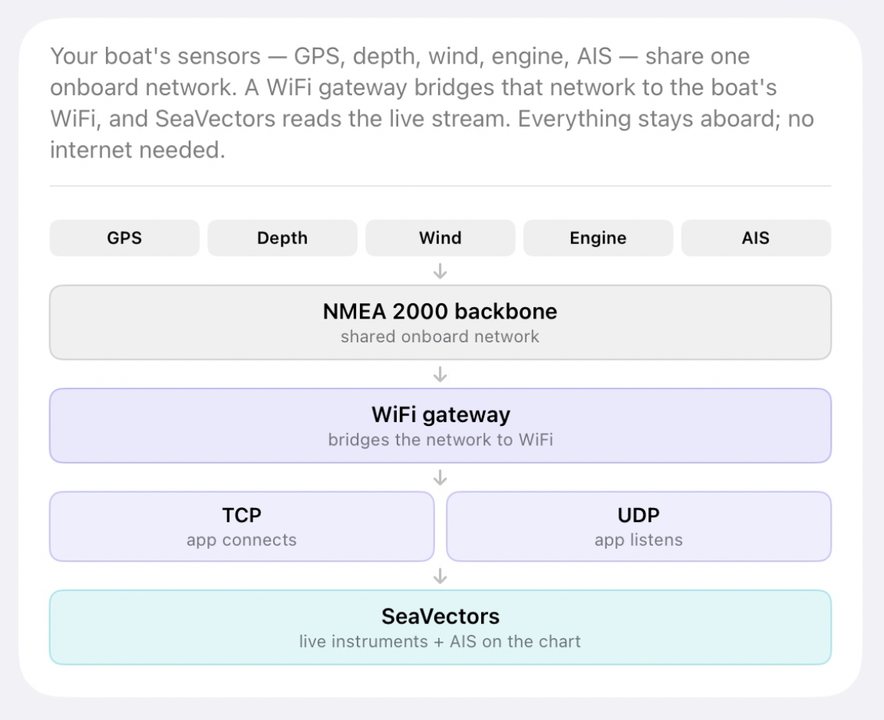
Your boat's sensors — GPS, depth, wind, engine, AIS — share one onboard
network. A WiFi gateway bridges that network to the boat's WiFi, and
SeaVectors reads the live stream. Everything stays aboard; no internet needed.
Want to connect SeaVectors to your boat and see live NMEA data in the app?
The 30-day free trial includes the complete experience, so you can evaluate SeaVectors with your own routes and equipment before deciding whether to subscribe.
- Download SeaVectors on the App Store
- Get SeaVectors on Google Play
- Not ready to install? Open the lightweight web chart for a quick preview.
Connecting
| TCP | Enter the gateway's host and port. Reliable and ordered; gateways limit how many apps can connect at once. |
| UDP | The gateway broadcasts to the whole network and the app just listens on the port — no host needed, unlimited devices. |
| Common ports | 10110 (B&G, Simrad, Lowrance, ShipModul) · 2000 (Digital Yacht) · 1456 (Yacht Devices) · 39150 (Vesper) |
| Format is automatic | NMEA 0183 and raw NMEA 2000 (Yacht Devices RAW, $PCDIN, $MXPGN) are detected automatically — nothing to configure. |
Data formats
| NMEA 0183 | The classic marine text format. Universally supported; carries position, depth, wind, heading, AIS and more. |
| NMEA 2000 (raw) | Read directly from the boat's data bus via Yacht Devices RAW, $PCDIN (SeaSmart) or $MXPGN (ShipModul). Adds instance-aware data 0183 can't carry — twin engines, multiple batteries and tanks. |
| Standards-tested | Decoding is verified against the NMEA 2000 PGN standard, reference tools, and real device output from Yacht Devices, Actisense and others. |
WiFi gateways
| Device | Notes | Format |
|---|---|---|
| Yacht Devices YDWG-02 | TCP or UDP, default port 1456. Serves NMEA 0183 and raw NMEA 2000 on separate ports at the same time. | NMEA 2000 (Yacht Devices RAW) + NMEA 0183 |
| Digital Yacht WLN10 / NavLink2 | TCP or UDP, port 2000. NavLink2 converts the NMEA 2000 bus to 0183. | NMEA 0183 |
| Actisense W2K-1 / W2K-2 | TCP or UDP, three configurable data servers. Its raw NMEA 2000 framing isn't read yet — run it in 0183 mode. | NMEA 0183 |
| ShipModul MiniPlex-3Wi | Port 10110, UDP by default. The 3Wi-N2K model also bridges the NMEA 2000 bus. | NMEA 0183 · NMEA 2000 ($MXPGN) on the 3Wi-N2K |
| Quark-elec QK-A032 | TCP, port 2000. NMEA 2000 ↔ 0183 gateway. | NMEA 0183 or NMEA 2000 ($PCDIN) |
| Signal K / OpenPlotter | TCP, port 10110. Configure it to emit raw PGNs for NMEA 2000. | NMEA 0183 · NMEA 2000 (Yacht Devices RAW / $PCDIN) |
Any gateway that serves NMEA data over TCP or UDP works — these are the
common ones.
AIS transponders with WiFi
| Device | Notes | Format |
|---|---|---|
| Vesper XB-8000 / Cortex | TCP, port 39150. AIS, GPS and instrument data. | NMEA 0183 |
| em-trak B952 / B954 | AIS and GPS data over WiFi. Doesn't convert NMEA 2000 instrument data. | NMEA 0183 (AIS + GPS) |
Chartplotters
| Device | Notes | Format |
|---|---|---|
| B&G Zeus / Vulcan · Simrad NSS, NSO, GO · Lowrance HDS, Elite | Enable “NMEA 0183 over WiFi” in the plotter's network settings, port 10110. | NMEA 0183 |
Garmin, Raymarine, Furuno, Humminbird
These plotters don't share NMEA data over WiFi with third-party apps. Add any
WiFi gateway above to the boat's NMEA 2000 backbone — it hears every sensor
directly, and the plotter keeps working unchanged.
What SeaVectors reads from NMEA 2000
| Navigation | Position, course & speed over ground, heading, rate of turn, heel & pitch. |
| Depth & speed | Water depth, speed through water, trip and total log. |
| Wind & environment | True and apparent wind, water & air temperature, barometric pressure with trend. |
| Engine & electrical | RPM, coolant temperature, engine hours, fuel rate, battery voltage & state of charge, fuel and water tank levels — per engine, battery and tank. |
| AIS traffic | Nearby vessels' position, course, speed, name, callsign and size — ranked by collision risk on the chart and in the AIS list. |
Instance-aware: twin engines, multiple battery banks and several tanks each
get their own reading.
Gateway & Device Compatibility
Once the connection method is clear, use this reference to confirm which gateways, AIS transponders, chartplotters, and raw NMEA 2000 formats work directly with SeaVectors.
Last updated July 23, 2026. Device support can change with firmware; confirm current settings in the manufacturer documentation before purchase.
Connection details at a glance
- TCP — the app dials the gateway (host + port). Reliable and ordered;
gateways limit simultaneous TCP clients (YDWG-02: 3). - UDP — the gateway broadcasts datagrams to the subnet; the app just
listens on the port. Unlimited devices can share one stream; no host to
configure. - No authentication anywhere — the boat's WiFi password is the perimeter.
Everything stays on the local network; works offshore with no internet. - Common ports: 10110 (Navico MFDs, ShipModul, convention), 2000
(Digital Yacht), 1456 (Yacht Devices), 39150 (Vesper).
iPhone and iPad: Broadcast UDP is not currently available on physical iOS devices. Use TCP or unicast UDP. Mac supports broadcast UDP.
Supported — dedicated WiFi gateways (their whole purpose)
| Brand | Model | Notes |
|---|---|---|
| Yacht Devices | YDWG-02 | NMEA 2000→WiFi; TCP (≤3 clients) or UDP; default port 1456; 3 independently configurable data servers |
| Yacht Devices | YDWN-02 | NMEA 0183→WiFi |
| Yacht Devices | YDWR-02 | 0183 WiFi router/multiplexer, 3 TCP/UDP servers |
| Digital Yacht | WLN10 Smart | 0183→WiFi; TCP/UDP port 2000; device at 192.168.1.1 in AP mode |
| Digital Yacht | NavLink2 | N2K→WiFi; TCP/UDP port 2000 |
| Actisense | W2K-1 / W2K-2 | N2K→WiFi; 3 data servers, TCP/UDP (W2K-2 is the current model) |
| Actisense | WGX-1 | combined 0183 + N2K WiFi gateway |
| ShipModul | MiniPlex-3Wi / 3Wi-N2K | 0183 multiplexer (+N2K/SeaTalk on -N2K); port 10110, UDP default / TCP option |
| Quark-elec | QK-A032 | budget N2K↔0183 gateway; TCP 192.168.1.100:2000 |
| DIY | Signal K / OpenPlotter (Raspberry Pi) | serves 0183 on TCP 10110 alongside Signal K |
Supported — AIS transponders with built-in WiFi
| Brand | Model | Notes |
|---|---|---|
| Vesper | XB-8000 | TCP port 39150 at 192.168.15.1; discontinued but common |
| Vesper (Garmin) | Cortex M1 | TCP 39150 at 10.1.1.1; Garmin documents third-party app use |
| em-trak | B952 / B954 | streams AIS + GPS + wired-0183 data; does not convert N2K instrument data |
Supported — MFDs with native NMEA-over-WiFi (Navico brands only)
| Brand | Models | Notes |
|---|---|---|
| B&G | Zeus² / Zeus³ / Zeus³S / Zeus S, Vulcan | Settings → Network → "NMEA 0183 over Ethernet/WiFi", TCP/UDP port 10110 |
| Simrad | NSS evo2/evo3/evo3S, NSO, GO | same Navico OS feature (NSX unverified — bench-test before claiming) |
| Lowrance | HDS Gen2 Touch → Carbon → Live → PRO, Elite Ti/Ti2/FS | same Navico OS feature |
Not supported directly — MFD WiFi is proprietary
These need one of the gateways above added to the boat's NMEA 2000 backbone
(the gateway hears every sensor on the bus directly; the MFD's cooperation is
not required):
| Brand | Models | Why |
|---|---|---|
| Garmin | all chartplotters (GPSMAP, ECHOMAP) | WiFi talks only to ActiveCaptain |
| Raymarine | Axiom / Axiom+ / Axiom 2 Pro/XL, Element | WiFi is for RayConnect + approved LightHouse apps |
| Furuno | NavNet TZtouch / TZT2 / TZT3 | proprietary NavNet protocol (Furuno's own apps only) |
| Humminbird | SOLIX, APEX, HELIX | One-Boat Network; 0183 exists only as a physical connector |
Direct NMEA 2000 (raw PGN) support — shipped
Additive: every device supported in NMEA 0183 mode keeps working
unchanged. Raw N2K unlocks instance-aware data (engine #1/#2, house vs
starter battery, tank levels) that 0183 structurally cannot express. Raw PGN
feeds come from dedicated gateways only — never from MFDs. All three
framings below are auto-detected; the supported framings are detected automatically.
| Device | Raw format | Framing | Status |
|---|---|---|---|
| Yacht Devices YDWG-02 / YDEN-02 | YD RAW | ASCII lines over TCP/UDP (hh:mm:ss.ddd R <CAN-ID> <8 hex bytes>) |
✅ Supported |
| Quark-elec QK-A032, Chetco SeaSmart | $PCDIN | raw PGN hex inside a normal 0183 $-sentence |
✅ Supported |
| ShipModul MiniPlex-3Wi-N2K | $MXPGN | PGN wrapped in an 0183-style sentence; mixed streams are normal | ✅ Supported (based on the vendor specification) |
| Signal K server (RPi / OpenPlotter) | any of the above, or Signal K JSON | configurable | ✅ Supported — configure it to emit YD RAW or $PCDIN (Signal K's own JSON is not read) |
| Actisense W2K-1 / W2K-2 | Actisense N2K / RAW | own binary + ASCII framings, needs a dedicated adapter | ❌ Not read — run the W2K in NMEA 0183 mode, where it works fully |
Yacht Devices RAW mode notes
- A YDWG-02 serves 0183 and RAW on different ports simultaneously —
switching modes in the app needs no rewiring. - RAW mode is enabled per data server in the gateway's own web UI.